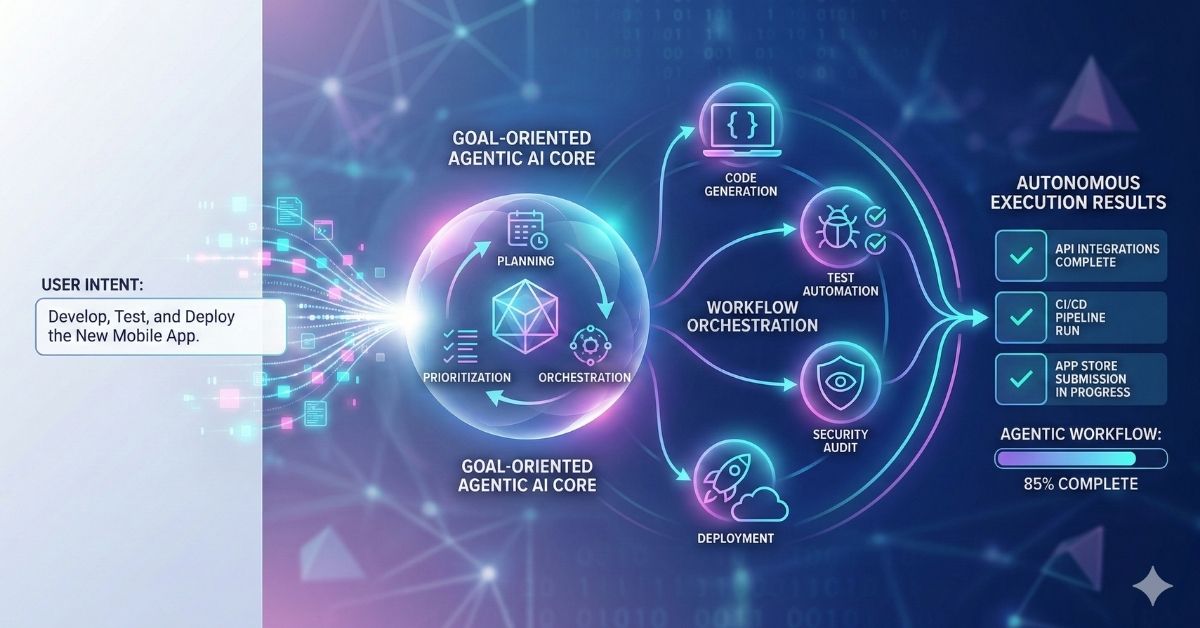
The era of “prompt-and-wait” is officially over. If 2024 was the year of the chatbot and 2025 was the year of the “Copilot,” 2026 has firmly established itself as the Year of the AI Agent. We are moving beyond reactive generative models to proactive, autonomous systems that don’t just write about work—they execute the work.
The Shift from Reaction to Agency
For the past few years, our interaction with artificial intelligence has been largely conversational. You ask a question, and the model provides an answer. This is “Reactive AI.” However, Agentic AI—the backbone of the 2026 tech revolution—operates on a different principle: Goal-Oriented Autonomy.
Instead of guiding an AI through every step of a task, users now provide a high-level objective. For example, instead of asking an AI to “write a follow-up email,” an agentic system is tasked to “manage the lead nurturing process for this client.” The agent then independently checks the CRM, analyzes previous interactions, drafts the email, schedules the send time, and updates the database once the task is complete.
Why 2026? The Technological Convergence
Several key factors have converged to make 2026 the tipping point for autonomous agents:
Multi-Agent Orchestration: We have moved from single models to “orchestrated digital workforces.” Modern enterprises now deploy teams of specialized agents that collaborate, peer-review each other’s work, and hand off tasks seamlessly.
Expanded Task Horizons: In 2025, AI tasks were measured in minutes. In 2026, agents can operate for days or even weeks, building entire software applications or managing complex supply chain disruptions with minimal human checkpoints.
Reliable Tool Use: Through advanced API integrations and “Agentic Workspaces,” AI can now navigate the web, use legacy software, and execute financial transactions with a level of precision that was previously impossible.
Industry Impact: Digital Guardians of Productivity
The impact of this shift is visible across every sector:
Software Engineering: Agents are now moving beyond “coding assistants” to “autonomous developers,” capable of refactoring entire codebases and managing the full software development lifecycle (SDLC) autonomously.
Finance and Compliance: Autonomous agents act as the first line of defense, capable of detecting and mitigating anomalies in real-time across global markets without waiting for human approval.
Customer Success: The “ServiceNow” model of an autonomous workforce means L1 service desks are increasingly managed by AI specialists that resolve incidents from start to finish.
Managing the “Agentic” Risk
With great autonomy comes a new set of challenges. As we empower agents to act on our behalf, the focus in 2026 has shifted from “model performance” to AI Governance and Runtime Supervision. Tools like “Guardian Agents” have emerged to monitor autonomous behaviors, ensuring they stay within ethical and operational guardrails.
Conclusion: The Human-Agent Collaboration
2026 is not about replacing humans; it’s about a structural redefinition of work. As agents take over the administrative and procedural drudgery, the value of human input is shifting toward strategic orchestration, system architecture, and ethical oversight.
At TechnoLogic, we believe the transition from “Chatbots” to “Agents” represents the most significant leap in productivity since the dawn of the internet. The question is no longer “What can AI tell me?” but “What can my AI agent achieve for me today?”